If you’re a 1099 real estate agent working the northern Wake County growth corridor in 2026, finding an accountant in Wake Forest, NC who actually understands commission income, quarterly estimated taxes, and the pace of a rapidly expanding suburban market can make the difference between a stressful tax season and a manageable one.
Key takeaways
- Wake Forest agents selling new construction along the northern Wake County expansion corridor face high transaction volume and irregular commission timing that makes quarterly estimated tax planning essential for 2026.
- New 1099 agents entering the Wake Forest market may owe self-employment tax at 15.3 percent plus NC’s flat 3.99 percent income tax, and missing quarterly deadlines triggers underpayment interest calculated on Form D-422 by the NC Department of Revenue.
- Remote accounting service delivery means Wake Forest-based agents can access bookkeeping, tax prep, and business formation support without commuting to Raleigh, with document exchange handled through a secure portal.
—
What Does an Accountant for Wake Forest, NC Real Estate Agents Actually Do?
A Wake Forest real estate agent accountant provides specialized services for 1099 commission-based agents working the northern Wake County market. That’s a different job than what a general tax preparer does. A general preparer typically handles W-2 returns, straightforward deductions, and standard filing. An accountant focused on commission income deals with something messier: irregular deposit timing, no employer withholding, self-employment tax on top of income tax, and business expense records that most agents aren’t tracking closely enough.
Wake Forest grew by approximately 11,000 residents from April 2020 to July 2024, per NC OSBM estimates. That growth has translated into new subdivisions across the northern part of the county, and a steady stream of newer agents entering the Wake Forest real estate market to work those transactions. Each closed deal is a commission deposit that needs to be categorized, matched against brokerage statements, and factored into quarterly payment calculations.
The service is delivered remotely. Wake Forest agents don’t need to drive into downtown Raleigh for a meeting. Document exchange happens through a secure portal, and accounting support covers everything from bookkeeping and tax prep to business formation guidance. This page exists to answer the question you searched: what does an accountant in Wake Forest, NC actually do for an agent like you, and do you need one?
For a broader look at how accounting works across the NC Triangle, see How Accounting and Taxes Work for Triangle Real Estate Agents.
—
How Self-Employment Tax and NC Income Tax Hit Wake Forest Agents
A 1099 Wake Forest real estate agent owes self-employment tax plus NC’s flat income tax on net commission income, and no brokerage withholds either one. That’s the core problem. When you’re an employee, your employer covers half of Social Security and Medicare taxes. As a 1099 agent, you cover the full amount yourself.
According to the IRS, the self-employment tax rate is 15.3 percent: 12.4 percent for Social Security (up to the wage base) and 2.9 percent for Medicare with no cap. The 2026 Social Security wage base is $184,500, meaning the 12.4 percent portion applies only up to that amount; the 2.9 percent Medicare portion applies to all net self-employment income (SSA, October 2025). Per NCDOR, the NC individual income tax rate is a flat 3.99 percent for 2026. Federal income tax sits on top of both, at bracket-based rates per IRS IR-2025-102.
| Tax | Rate | Notes | |—–|——|——-| | Federal self-employment tax | 15.3% | 12.4% SS up to $184,500 wage base; 2.9% Medicare, no cap (IRS / SSA) | | NC individual income tax | 3.99% (flat) | Applies to net self-employment income after allowable deductions (NCDOR) | | Federal income tax | 10% to 37% (bracket-based) | Top rate of 37% applies above $640,600 single / $768,700 MFJ (IRS IR-2025-102) |
One partial offset worth knowing: the IRS allows a deduction for one-half of self-employment tax, which reduces your adjusted gross income before income tax is calculated. That doesn’t eliminate the bill, but it reduces what income tax applies to.
This table is general education only, not tax advice for your situation. Talk to a tax professional about how these rates apply to your specific income level.
—
How Do Quarterly Estimated Taxes Work for Wake Forest Real Estate Agents?
A Wake Forest 1099 agent must file quarterly estimated payments to both the IRS and NCDOR to avoid underpayment penalties, because no employer is sending anything in on their behalf throughout the year. Here’s how that process works, step by step.
- Know the due dates. Per NCDOR and the IRS, quarterly estimated tax payments are generally due April 15, June 15, September 15, and January 15 of the following year. The January payment is not required if you file your full return and pay in full by January 31.
- Calculate net commission income for the period. Subtract allowable business expenses from gross commission income received during the quarter. What’s left is the number you estimate tax on.
- Estimate your federal self-employment tax. Apply the 15.3 percent rate to your net self-employment income, then factor in the one-half SE tax deduction before calculating federal income tax.
- Estimate your NC tax. Per NCDOR, use Form NC-40 for each quarterly payment. You can file NC-40 and pay online through NCDOR eServices.
- Check whether NC estimated payments are required. According to NCDOR, estimated income tax payments are required when the tax due on your NC return, minus NC withholding and credits, is $1,000 or more. Below that threshold, you’re not required to make quarterly payments, though you’ll owe the balance at filing.
- Track underpayment exposure. If you miss or underpay a quarterly installment, underpayment interest is calculated on Form D-422 by the NC Department of Revenue.
Wake Forest agents who also cover Rolesville and Youngsville adjacent markets often accumulate more driving than they expect. Mileage is a deductible business expense that reduces net income, which in turn reduces what you owe each quarter. The 2026 IRS business mileage rate splits mid-year: 72.5 cents per mile from January 1 through June 30, then 76 cents per mile from July 1, 2026 (IRS). That split requires agents to log trips by date, not just total miles.
General education only, not tax advice for your situation. The Raleigh real estate market and the broader Triangle agent community face the same quarterly structure; this is a statewide NC requirement, not specific to Wake Forest.
—
Bookkeeping for Wake Forest Real Estate Agents: What Records You Need to Track
Wake Forest real estate agent bookkeeping requires tracking commission deposits, business expenses, mileage logs, and transaction-related costs across what can be a high-volume, clustered-payment market. New construction closings in particular tend to batch: a wave of closings in a subdivision can land several large commission checks in the same month, followed by quieter periods. Without organized records, that pattern makes cash flow hard to manage and estimated tax calculations difficult to get right.
Here are the core records a Wake Forest agent should maintain year-round:
- Commission deposit records tied to each transaction closed, including the property address and closing date. New construction agents in particular should match each deposit against the brokerage commission statement.
- Mileage log covering trips to listings, showings in Rolesville and Youngsville, open houses, and client meetings. Log each trip by date so you can apply the correct 2026 IRS split rate: 72.5 cents per mile through June 30, 76 cents per mile from July 1 (IRS).
- Desk fees and brokerage split documentation. What you pay your brokerage reduces your net commission income. Keep every statement.
- Marketing and advertising expenses. Signs, photography, online ads, and similar costs are generally deductible business expenses.
- Doorify MLS (formerly Triangle MLS) membership dues and association fees. These are ordinary business expenses for agents operating in the Triangle market.
- Home office expenses, if applicable. If a portion of your home is used exclusively and regularly for business, you may want to talk to a tax professional about whether the home office deduction applies.
- Continuing education costs. Course fees, materials, and related expenses for maintaining your NC license may qualify as deductible business expenses.
Bank reconciliation keeps commission deposits matched against brokerage statements, catching discrepancies before they become a problem at tax time. A secure document portal lets Wake Forest agents upload receipts and bank statements without driving to Raleigh or Durham. Wake Forest’s downtown and the new subdivisions spreading across northern Wake County form the primary work geography for most agents here, and that geography generates the records this list covers.
—
Is an LLC or S-Corp Worth It for a Wake Forest Agent? Business Formation Basics
Wake Forest real estate agent business formation must comply with NCREC firm license requirements before an entity can receive commissions, and that requirement shapes every conversation about LLCs and S-Corps. Per NCREC Rule 21 NCAC 58A .0502, a business entity in NC must hold a firm license from the NC Real Estate Commission before it can receive real estate commissions. Paying commissions to an unlicensed entity is contrary to NCREC rules.
There are also agent-status rules that matter. A provisional broker cannot be paid through an LLC or S-Corp until provisional status is removed, which requires completing 90 hours of post-licensing education. Until that’s done, commissions are paid to the agent personally.
| Entity Type | Key Feature | NC-Specific Consideration | |————-|————-|—————————| | Sole proprietor | No formation required | No firm license needed; commissions paid directly to the agent | | LLC | $125 Articles of Organization filing fee; $200 annual report fee (NC Secretary of State) | Must hold NCREC firm license before receiving commissions | | S-Corp | Federal tax election; NC franchise tax minimum $200/year | Must hold NCREC firm license; provisional brokers ineligible until status removed |
One structural note: a one-broker S-Corp formed only to receive that broker’s commissions, with no office and no other people associated with it, does not need to designate a broker-in-charge under NCREC Rule 58A .0110. Hiring even a part-time assistant removes that exception.
Wake Forest agents who are building team structures or bringing on help should understand how the firm license and broker-in-charge rules interact before adding staff. The Independent Agent Launch Program is designed for agents at the solo or early-team stage who are sorting out these decisions for the first time.
This section is general education only, not legal or tax advice for your situation. Consider talking to a tax professional about which structure makes sense given your income level and plans.
For related guidance on business registration questions, see Do Real Estate Agents Need a Raleigh Business License? (Plus Wake County Listing Rules).
—
How Wake Forest Agents Can Get IRS and Tax Problem Help Remotely
A Wake Forest real estate agent accountant offers remote tax services including amended returns and penalty abatement guidance for agents who are dealing with past problems, not just current-year filings. If you have unfiled prior year returns, missed quarterly payments, or an IRS notice sitting on your desk, those issues can be addressed without traveling to Raleigh or Durham.
Services available remotely include:
- Amended tax return preparation for prior years where income, deductions, or filing status were reported incorrectly
- Prior year tax return filing to get unfiled returns current
- Education on IRS payment plan options for agents who owe a balance they can’t pay in full
- Information on the Offer in Compromise program for agents who may qualify to settle for less than the full amount owed
According to the IRS, taxpayers who cannot pay their full balance may request an installment agreement or, in limited qualifying circumstances, an Offer in Compromise to settle for less than the full amount owed. Penalty abatement options also exist in certain situations, though qualification depends on individual circumstances.
All document exchange happens through a secure portal. The starting point for any Wake Forest agent who wants to understand where they stand is a Complimentary Tax Analysis: a no-obligation assessment of your current tax situation. Request your Complimentary Tax Analysis here.
General education only, not tax advice for your situation. You may also want to explore the Tax Accountant for Raleigh Real Estate Agents page for additional context, or see the full Areas We Serve in the Triangle to find the right starting point for your location.
—
Frequently asked questions
Do I need a Wake Forest accountant who specializes in real estate agents, or can any local tax preparer help?
A general tax preparer may not be familiar with the specific challenges of 1099 commission income, self-employment tax calculations, quarterly estimated payments, or NC-specific rules like the NCREC firm license requirement for entities receiving commissions. An accountant focused on Wake Forest real estate agents will understand the transaction patterns of the northern Wake County new construction market and the irregular timing of commission deposits. General education only, not tax advice for your situation.
What is the NC income tax rate for a Wake Forest real estate agent in 2026?
Per the NC Department of Revenue, the NC individual income tax rate is a flat 3.99 percent for tax year 2026, down from 4.25 percent for 2025. This applies to net self-employment income after allowable deductions. The NC standard deduction is $12,750 for single filers or $25,500 for married filing jointly, as set in N.C. Gen. Stat. 105-153.5. General education only, not tax advice for your situation.
How do mileage deductions work for a Wake Forest agent covering Rolesville and Youngsville?
According to the IRS, the 2026 business standard mileage rate is 72.5 cents per mile from January 1 through June 30, 2026, and increases to 76 cents per mile from July 1, 2026, requiring agents to track trips by date to apply the correct rate. Wake Forest agents who regularly cover adjacent markets like Rolesville and Youngsville may accumulate significant deductible mileage, making a contemporaneous mileage log essential. You may want to talk to a tax professional about which driving activities qualify as deductible business mileage under IRS guidelines.
Services for Wake Forest real estate agents
- Financial Setup for New NC Real Estate Agents
- LLC and S-Corp Setup for NC Real Estate Agents
- Accounting Services for Raleigh Real Estate Agents
- Tax Preparation for Self-Employed NC Real Estate Agents
- Monthly Bookkeeping for Raleigh Real Estate Agents
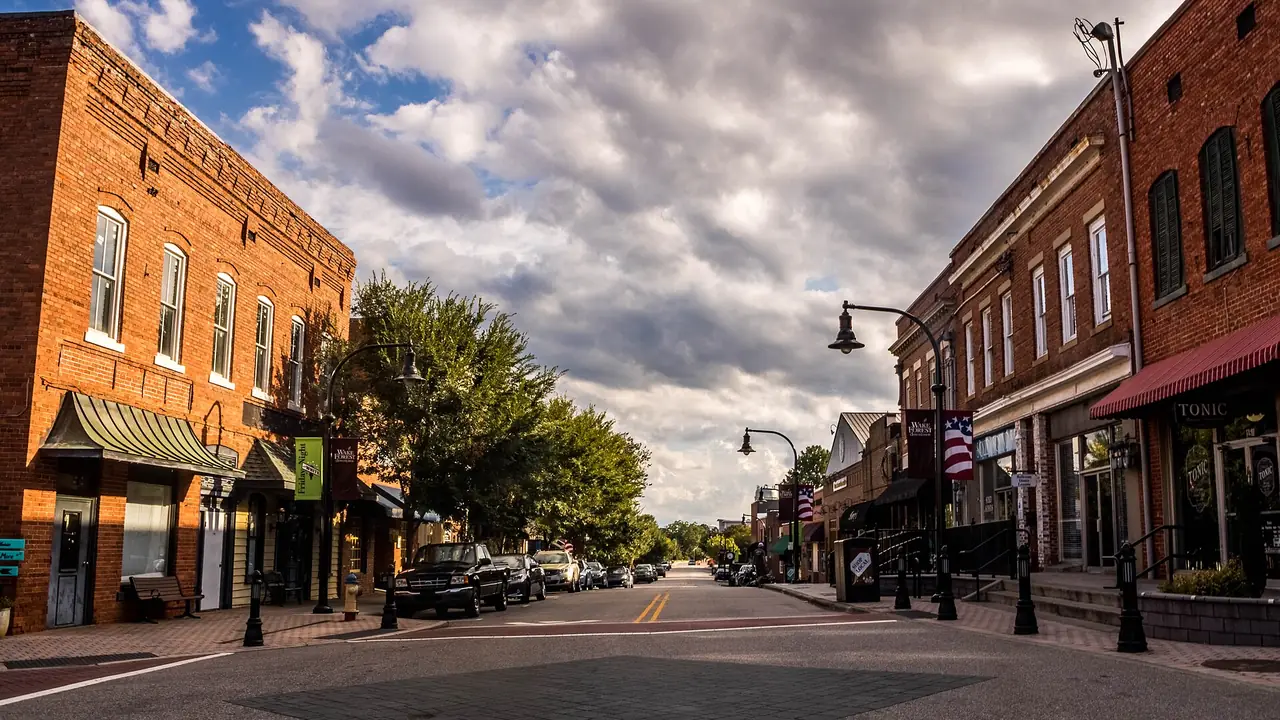
Header photo: Rysnap1024, CC BY-SA 4.0, via Wikimedia Commons.
